SANZO JOURNAL · 冷切口与火抛口的工艺差别、触感与安全、高端酒杯为什么必须火抛
The Fire-Polished Rim: What Your Lips Already Know
4 min read
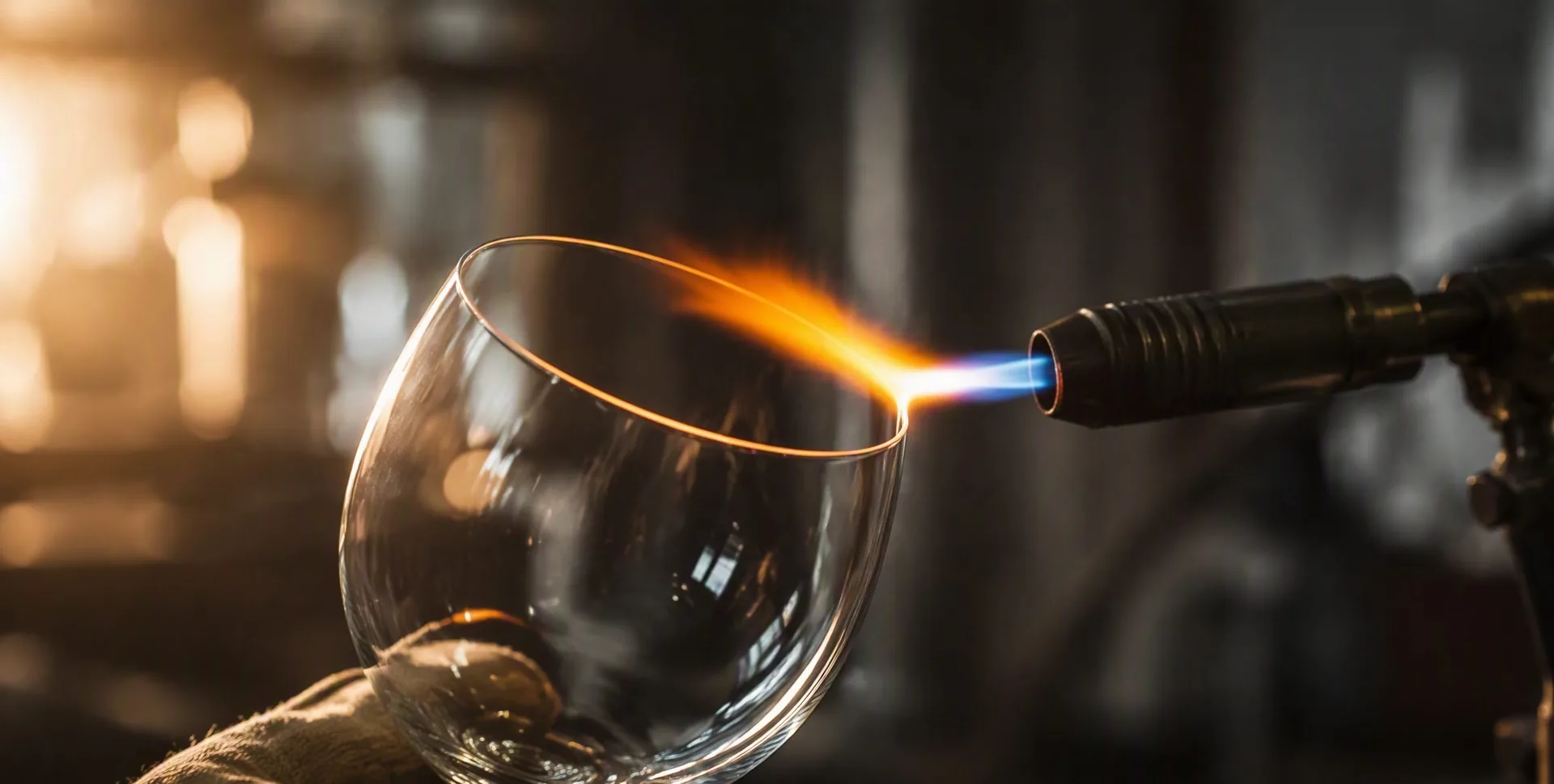
The moment a glass reaches your lips, the first thing you notice isn't the silhouette or the pattern — it's the rim, that sub-millimeter arc of glass where mouth meets vessel. Cold-cut versus fire-polished: on paper, they sound like two interchangeable finishing options. On the lips, the difference is between being nicked and being caught.
Cold-Cut Rim: Precision with an Edge
Cold-cutting grinds the formed rim on a diamond wheel to produce a perfectly even, straight-edged finish. Its strength is dimensional accuracy: rim diameter tolerance can be held within ±0.5 mm, making it ideal for high-volume production where tight specs matter. But glass is, at heart, a fractured silicate surface. No matter how finely it is cut, the microscopic edge remains just that — fractured.
That is why a cold-cut rim must always undergo a secondary fire-polishing pass — at least 800 °C melts the surface layer in an instant, causing it to retract and seal, closing micro-cracks invisible to the naked eye. Skip this step and the rim will continue to shed microscopic glass particles during shipping and washing, creating a long-term safety concern.
Fire-Polished Rim: Smoothness Written in Flame
Fire-polishing is performed while the glass still holds residual heat: a concentrated flame above 1,200 °C is swept around the rim in one continuous rotation, allowing the glass to naturally retract into a closed, full, gently curved lip line. It doesn't grind the edge flat — it grows it round.

- Touch: a fingertip glides without resistance; the rim meets the lip like fine porcelain — no snagging, no scratching.
- Light: under a lamp, the rim displays an unbroken band of specular highlight, with none of the tell-tale 'white line' or matte patches common to cold-cut edges.
- Durability: fire-polishing seals micro-cracks, markedly improving chip resistance; the rim withstands repeated cycles in commercial dishwashers.
- Safety: zero risk of glass-particle shedding, giving end-users confidence through years of daily use.
Why Premium Glassware Demands Fire-Polishing
A tasting-glass rim has two jobs: guide the liquid onto the palate, and funnel aromas toward the nose. The sharp, right-angled edge of a cold-cut rim causes the wine to 'break' as it flows, severing the aromatic stream. The gentle micro-curve of a fire-polished rim acts like a soft watershed, spreading the liquid into a thin film and letting the bouquet release gradually. That is why, from Burgundy bowls to Old Fashioned tumblers, every shape whose selling point is the tasting experience finishes its rim at the flame.
The Shangzhuo Way: Fire-Polishing as a Promise
Here in Qixian, Shangzhuo has spent fifteen years doing one thing: keeping 156 artisans working across an unbroken chain from blowing to finishing. Our fire-polishing is never outsourced — it is a handoff between the blower and the finisher, side by side on the same shop floor. Glass temperature, flame angle, rotation speed: these are governed by experience, not instruments. We export to more than thirty countries, and the question we hear again and again is, 'Can your fire-polish stay consistent?' Our answer: consistency doesn't come from machines. It comes from keeping the same team on the same line, accountable for every single rim they touch.
That fraction-of-a-millimeter arc at the rim is the shortest distance between maker and drinker. If you are sourcing glassware for your brand, or weighing the trade-offs between fire-polishing and cold-cut-then-polish, bring us your specific questions — we believe good craft stands up to being asked about, again and again.
fire polished rimcold cut rimhand-blown glasswarepremium drinking glassesrim finishingglass fire polishingB2B glassware supplierQixian glass manufacturer
Reading this far means you choose suppliers carefully
Tell Xiaozhuo what you have in mind — a few sentences are enough; we handle the rest.
Start a smart inquiry