SANZO JOURNAL · 内应力的成因、退火窑(Lehr)的作用、退火不良的后果、买家如何验证退火质量
The Annealing Curve: Why a Quality Glass Doesn't Shatter on Its Own
4 min read
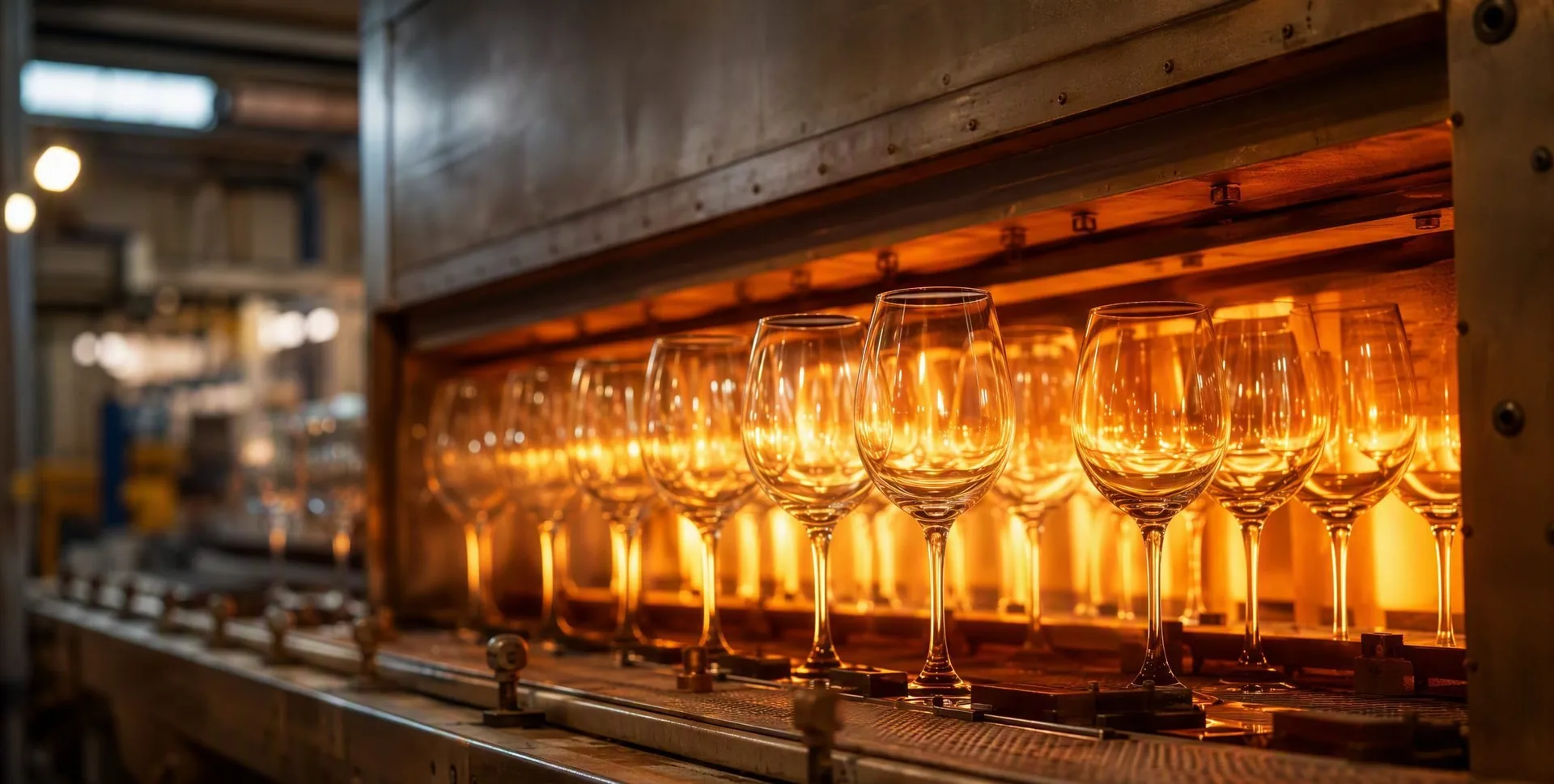
At 3 a.m., the temperature controller on the annealing lehr flickers. The night-shift technician stays alert, eyes locked on the curve — between 540°C and 480°C, the cooling rate must stay under 1.2°C per minute. Push it faster and the glass looks fine today, only to crack on its own at some ungodly hour three months from now. This isn't a cautionary tale; it's a root cause of returns the glass industry deals with every year.
Internal Stress: The Hidden Flaw Baked In Before the Glass Ever Ships
In handblown glassmaking, the journey from a 1,300°C molten gather to a finished shape takes mere seconds. Uneven wall thickness, thermal shock from contact with the mold, and localized reheating during secondary processing all create internal tension — residual stress. A well-annealed glass sits quiet and stable; a stressed one is like a mainspring wound a turn too tight, waiting to release.
The trouble is, internal stress is invisible to the naked eye. A glass that feels smooth and looks crystal-clear is not necessarily relaxed on the inside. That is precisely why annealing exists.
The Annealing Lehr: A Forty-Meter Tunnel for Stress Relief
An annealing lehr is not an oven — it is a long, precisely controlled temperature tunnel. Glass is first heated to its annealing point (roughly 540°C–560°C, depending on the glass composition), giving the molecular structure just enough mobility to release locked-in stress. It then passes through a slow-cooling zone near the lower annealing limit (about 460°C–480°C), minimizing the temperature gradient between the inner and outer walls. Only after that does the glass enter the rapid-cooling section. The entire cycle takes 40–60 minutes, and the glassware travels roughly forty meters through the lehr.
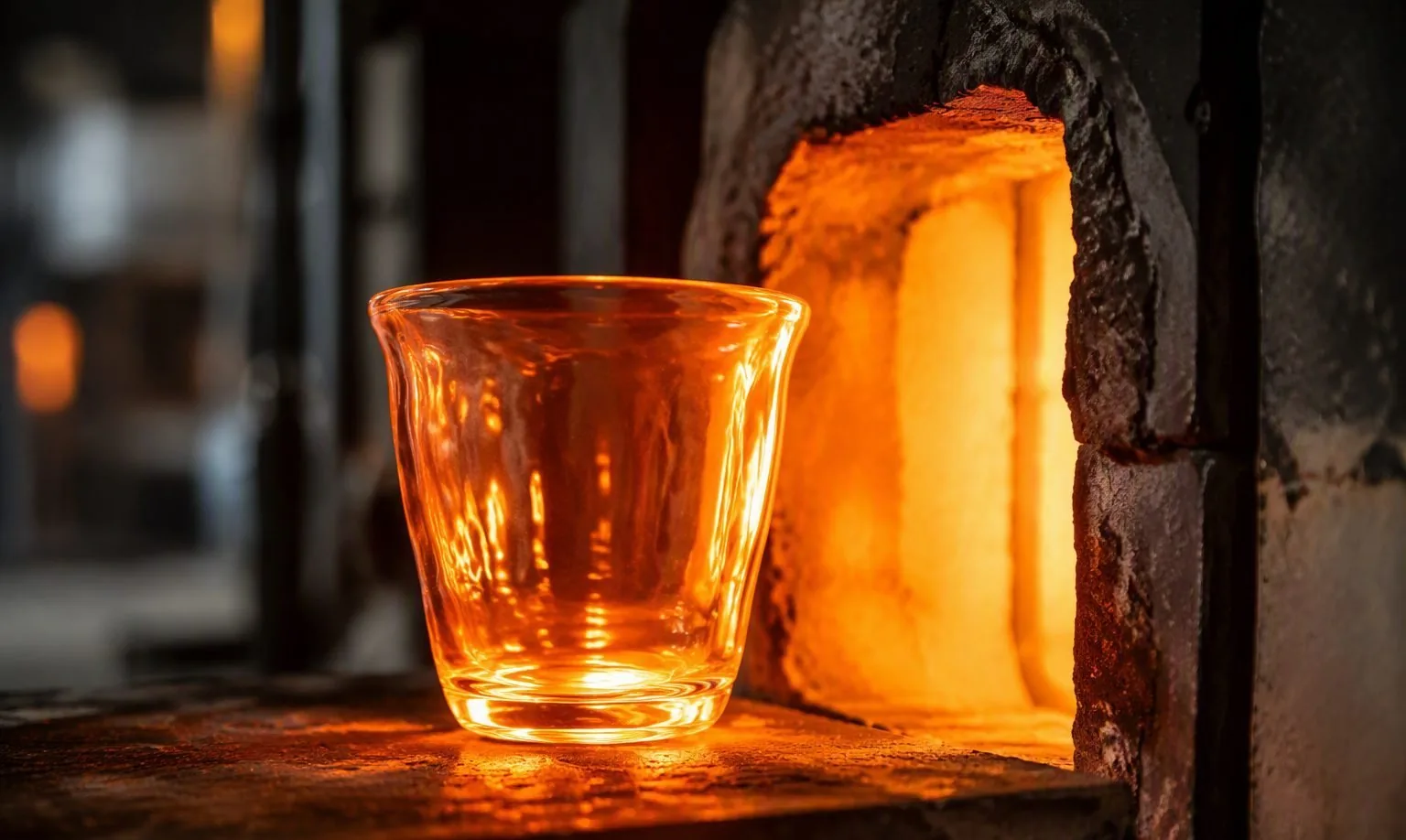
- Soak-zone uniformity: Lateral temperature variation inside the lehr must stay within ±3°C — otherwise one side relaxes while the other tightens, creating even more complex stress patterns.
- Slow-cool rate: This is the single biggest factor governing residual stress levels. Thick-walled tumblers and stemmed glass demand a gentler slope; they cannot share the same curve as thin-walled pieces.
- Rapid-cool onset: Fans must not engage until the glass has dropped below the lower annealing limit. Blowing air too early undoes everything that came before.
- Loading density: If glasses are packed too tightly on the lehr car, hot air cannot circulate properly — the piece in the center and the one at the edge end up with completely different annealing results.
The Cost of Poor Annealing: From Base Cracks to Full-Container Returns
Improperly annealed glass tends to reveal its flaws at three critical moments. First, during secondary processing — decorating, screen printing, or laser engraving reintroduce localized heat, stacking new stress on old until the glass shatters outright. Second, in transit — even mild vibration can trigger radial cracks radiating from the base. Third, at the end-user's table — the moment hot water is poured in, the wall splits open. For buyers, the first two failures can still be caught in the warehouse; the third has already damaged your brand.
Sanzo's Annealing: One Curve, Refined Over Fifteen Years
In Qixian — the heartland of China's handblown glass industry — Sanzo has been at work for fifteen years. Our 156 artisans handle every step: blowing, kiln-forming, cutting, frosting, ion plating, screen printing, and laser etching. A fully integrated production chain means our annealing standard isn't just 'survives the factory floor' — it's 'survives every downstream process we and our clients put it through.' We export to more than 30 countries, supplying hotel groups in Northern Europe, F&B chains across the Middle East, and branded buyers in North America — all of whom specify stress-testing requirements in their contracts. Our lehr curve wasn't copied from an equipment manual; it was tuned batch by batch, kiln by kiln, by our master technicians.
How Can Buyers Verify Annealing Quality?
The most reliable instrument is a polariscope. Place the glass in a polarized light field, and areas of high stress reveal vivid colored fringes — the denser and more saturated the fringes, the greater the stress. Standard industry practice is to sample three critical zones — the base, the rim, and the junction where the stem meets the bowl — and compare readings against the agreed stress grade (such as ISO 7458 or the buyer's internal specification). Buyers without access to a polariscope should request per-batch stress-test photos and lehr curve logs from their supplier. A factory willing to show you its curve is usually a factory confident in it.
Whether a glass will crack on its own is decided long before it leaves the factory. If you're wrestling with annealing specs, testing protocols, or process details, bring your samples, your orders, and your questions — we're happy to talk. No empty promises, just what we can actually deliver.
glass annealingannealing lehrinternal stressstress testingpolariscopehandblown glasswareQixian glasswholesale glassware
Reading this far means you choose suppliers carefully
Tell Xiaozhuo what you have in mind — a few sentences are enough; we handle the rest.
Start a smart inquiry