SANZO JOURNAL · 玻璃表面光泽的来源、火抛与化学抛光(电光水)工艺改良、光泽度的持久性
Fire Polishing vs. Chemical Polishing: How Glassmakers Define Lasting Brilliance
4 min read

When a glass leaves the annealing lehr, its surface is already smooth. But seasoned buyers know that smoothness is lifeless—like an unsharpened blade. What truly brings glass to life is one final pass of light. Where that light comes from determines how long the piece will shine on the shelf.
Fire Polishing: Self-Healing at High Temperature
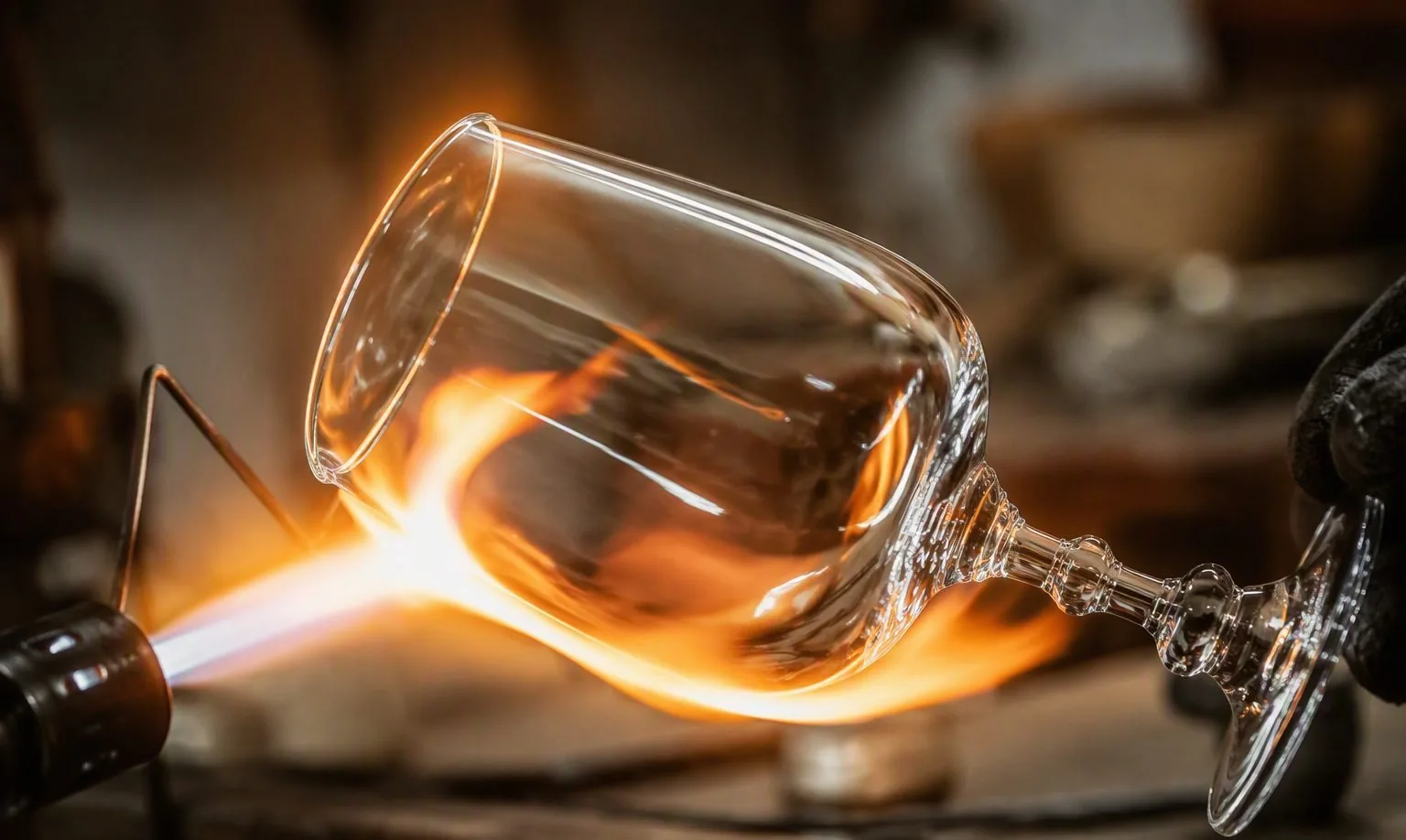
The principle behind fire polishing is straightforward: a high-temperature flame—typically above 1,200 °C—sweeps rapidly across the glass surface, melting an ultra-thin layer that then flows and resolidifies. At the microscopic level, the faint mold marks and seam lines left by production are smoothed out by surface tension. The glass, in effect, heals itself.
The brilliance of fire-polished glass is soft. It never glares; instead, it offers a warm, gentle reflection reminiscent of the patina on aged silver. The trade-off is demanding: the flame must be perfectly even, and the artisan's hand speed, angle, and distance must be exact—a fraction of a second off and the piece is scrap. In our workshops, a veteran fire-polisher's eye is the most accurate pyrometer on the floor.
Chemical Polishing: An Efficiency Revolution
Chemical polishing takes a different approach. A blended solution of hydrofluoric and sulfuric acid etches away a microscopic layer of the glass surface, leveling out irregularities at the micro-scale. The process is extremely efficient—ideal for high-volume, standardized production—and delivers gloss readings that are often numerically higher and visually "harder" than fire-polished finishes.
Yet the controversy lies in the very mechanism of chemical polishing. The acid-etched surface has a micro-structure that is effectively "opened up," with slightly higher porosity than a fire-polished surface. This means:
- Initial gloss is high, but prolonged contact with water and detergents accelerates gloss decay
- Incomplete rinsing of acid residue may affect food safety and cause odor issues
- Polishing uniformity on complex geometries—deep grooves, embossed details—is more controllable
- Environmental compliance pressure is growing, and waste-liquid disposal costs rise year on year
The SanzoHome Approach: Mastering Both—And Knowing When to Use Each
After fifteen years in the glassware capital, our team of 156 artisans covers every step of the production chain—from mouth-blowing and kiln-forming to cutting, frosting, ion plating, screen printing, and laser etching. That breadth means we never have to choose between fire polishing and chemical polishing. Experience exporting to over 30 countries has taught us: premium hospitality clients expect the warmth and durability of fire-polished glass, while FMCG brands and large-volume orders benefit from the cost efficiency of chemical polishing.
Our commitment is this: regardless of the polishing method, downstream washing and quality control must be airtight. Brilliance is not a number at the moment of shipment—it is the reason a buyer reorders three years later. Being a thoughtful supplier means never hiding the trade-offs of a process; it means placing those trade-offs exactly where they belong.
The Philosophy of Shine
Fire-polished glass feels handmade—warm, alive, with character. Chemically polished glass feels industrial—precise, efficient, consistent. Neither is superior; the right choice depends on your product lifecycle and brand story. If you're weighing polishing options for your next order, bring us your product images, target market, and budget range. We won't tell you which method is "better"—we'll tell you which one is better for you.
fire polished glasswarechemical polishingglass polishing techniquesglassware finishingglass surface treatmentHuoxian glassware manufacturerglassware OEM supplierSanzoHome
Reading this far means you choose suppliers carefully
Tell Xiaozhuo what you have in mind — a few sentences are enough; we handle the rest.
Start a smart inquiry